
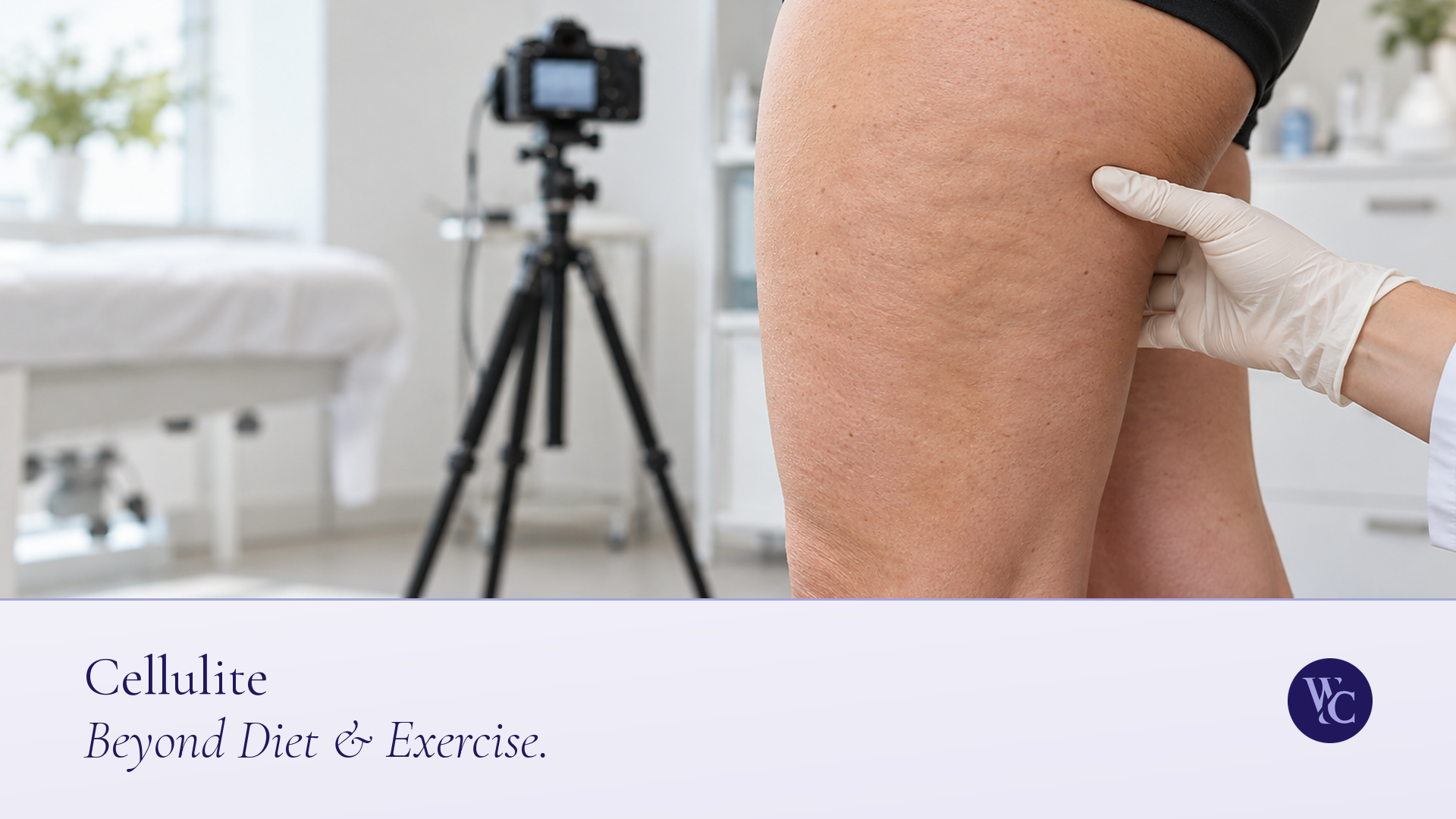
One photograph makes your skin look smoother. Another, taken a few minutes later, seems to reveal every indentation. When you are trying to assess cellulite treatment progress, that difference can be confusing. It can also make a promising change appear larger than it is or make a genuine improvement harder to recognize.
For patients researching cellulite treatment Miami, before-and-after images are often an important part of choosing a provider and setting expectations. However, an image is only useful when you understand how it was taken, when it was captured, and what it is intended to demonstrate. A photograph taken under different conditions may show a different presentation of the skin rather than a treatment effect.
At WaltCare Clinic in Miami Lakes, patients can discuss how their concerns would be assessed and how progress could be reviewed during follow-up. This article offers questions and practical documentation ideas for that conversation. It does not replace an examination or establish a photography protocol that the clinic necessarily uses.
Define What You Are Trying to Assess
Before comparing photographs, clarify the treatment objective. Are you discussing the visibility of specific dimples, a broader area of uneven texture, or another concern? A statement such as “my thighs look different” leaves considerable room for interpretation. A more specific objective makes later discussions easier.
Ask the provider to identify the area being assessed and explain what kind of change the proposed treatment is intended to address. The comparison should then return to that same concern. If the objective involves a particular group of dimples, a photograph showing a wider silhouette may not answer the relevant question.
Your own priorities matter too. You may be most concerned about how the skin appears while standing naturally, rather than under conditions designed to make every surface irregularity visible. Discuss that preference before agreeing on how progress will be reviewed.
Why Lighting Can Change the Appearance of Cellulite
Lighting influences the shadows that make surface texture visible. A comparison becomes difficult to interpret when the light comes from a different direction, has a different intensity, or exposes one image more brightly than the other.
A study evaluating a standardized cellulite assessment tool controlled lighting and patient position across photography sessions. Its methods also noted that overexposure can conceal cellulite appearance. These details help explain why a brighter “after” image should not automatically be interpreted as smoother skin.
The practical lesson is consistency. You do not need to search for lighting that makes your skin look its best or worst. You need a repeatable setup that allows the provider to compare the same area meaningfully.
Repeat the Setup Instead of Chasing a Flattering Image
If your provider recommends home photographs, ask how they should be taken. A useful personal note might record the room, light source, camera position, and whether flash was used. Keep the original images rather than adjusting brightness independently until they appear comparable.
If the setup changes, label that difference. It is more useful to acknowledge that a photograph was taken elsewhere than to treat it as an exact match for the baseline.
Match Posture and Muscle State
Body position is another important part of a fair comparison. A standing image with relaxed muscles should not be casually compared with an image taken while deliberately contracting or changing stance.
In a study validating cellulite dimple assessment scales, researchers standardized framing, lighting, and orientation and recorded both resting and contracted views. Those were distinct assessment conditions, not interchangeable photographs.
For your own follow-up, ask which position the clinician wants to assess. If several views are requested, keep each view clearly identified. Comparing like with like is more informative than choosing whichever pair produces the most dramatic contrast.
Use a Repeatable Position
A practical record can identify where you stood, which direction you faced, and whether the image shows a relaxed or contracted position. The provider can explain what is appropriate for the treatment area and assessment.
Avoid pinching, stretching, or manually smoothing the skin to produce a preferred appearance unless that is part of a clinician-directed assessment. If a special maneuver is used, it should be documented and interpreted in that context.
Keep Camera Distance, Height, and Framing Consistent
A close-up can be useful for seeing a particular indentation, while a wider image can show where that concern sits within the treatment area. Problems arise when one type of image is used as the baseline and another is presented as its direct comparison.
Research on standardizing photography for cellulite addresses photography as a specific part of assessment. Similarly, clinical studies have controlled camera placement and framing rather than relying on casually selected snapshots.
For a practical comparison, ask the provider what views are needed and how much of the area should be visible. A phone held at a different height or distance may not reproduce the original view, even when you are standing in the same room.
Preserve the Original Files
Keep unedited originals with their capture dates. If a crop is needed to show a particular area, preserve the full image as well. Avoid beauty filters, skin smoothing, reshaping tools, and selective retouching in progress records.
A crop should help identify the same region, not remove context that changes the interpretation. If an image has been edited for presentation, that should be clear to anyone reviewing it.
Record Timing in Relation to Treatment
“Before” and “after” are incomplete labels. A more useful record includes the image date, the treatment date, and where that photograph falls within the planned follow-up schedule.
Ask your provider when the proposed treatment should be evaluated. A photograph taken immediately after an appointment and one taken at a later review answer different questions. Without that timing information, it is easy to compare images that were never intended to represent the same stage of assessment.
The FDA’s guidance on non-invasive body contouring technologies explains that some procedures may produce temporary effects and that individual outcomes may not match expectations. Ask which limitations apply to the specific procedure being proposed and when reassessment would be appropriate.
Follow a Planned Review Schedule
Agree on a useful documentation schedule rather than taking photographs whenever you feel especially optimistic or concerned. A planned record gives the clinician a clearer sequence to review.
If something worries you between scheduled visits, contact the treating team. Do not wait for the next progress photograph to ask about a symptom or assume that a visually reassuring image rules out a problem.
Use Photographs as Part of an Assessment
Even well-matched photographs are not a complete clinical evaluation. They document appearance under particular conditions, but they do not independently establish every aspect of treatment response.
A study comparing cellulite assessment methods found poor correlation between some instrumental measurements and clinical photographic evaluations. That finding illustrates why different tools should not be treated as though they all measure exactly the same thing.
Ask how your provider combines the examination, photographs, and your own observations. If a grading scale is used, request a plain-language explanation of what the score represents and what it does not establish. Avoid turning a personal photograph into a self-assigned clinical measurement.
Describe Your Experience Without Forcing a Percentage
Patients sometimes want a single number to summarize improvement. However, an informal statement such as “50% better” can mean different things to different people unless the measurement method is defined.
You can provide more useful feedback by describing the specific change you notice. For example, identify the area, the viewing condition, and whether the appearance feels consistently different. You can also say that you are unsure. Uncertainty is a valid observation and a reason to review the record together.
Keep appearance, satisfaction, and expectations separate. You may notice a visible change while still feeling that the result does not address your original priority. Conversely, you may be satisfied with a modest change that would not look dramatic in a promotional image.
A Practical Progress Record to Discuss With Your Provider
The following template can help organize questions and observations. It is a personal documentation aid, not a validated cellulite severity scale.
|
Record item |
What to note |
|
Original concern |
The specific texture or dimples you want assessed |
|
Treatment area |
The same identifiable region at each review |
|
Image date |
When the photograph was captured |
|
Treatment timing |
How the date relates to treatment and follow-up |
|
View and posture |
Direction, stance, and relaxed or contracted state |
|
Photography setup |
Camera, distance, height, lighting, and flash |
|
Image changes |
Any cropping or adjustments |
|
Personal observation |
What looks different, unchanged, or uncertain |
|
Questions for review |
Points to discuss with the treating professional |
Bring the original images to the review rather than only a collage. A collage can make comparison convenient, but the underlying files preserve more context.
How to Read Promotional Before-and-After Images
When considering cellulite treatment Miami providers, look beyond the size of the apparent transformation. Ask whether the photographs use comparable lighting, posture, framing, and timing. Also ask what treatment was performed and how many appointments the example represents.
An individual example can illustrate one person’s experience, but it cannot establish what another patient will achieve. The FDA notes that not everyone responds to body contouring procedures or obtains the desired effect. A consultation should connect the recommendation to your own assessment rather than using someone else’s photograph as a promise.
Questions Worth Asking
A useful discussion can include:
- Are these images of the same area under comparable conditions?
- When were they taken relative to treatment?
- How many treatment sessions does the example represent?
- Were other procedures performed during that period?
- What aspect of the appearance is the image intended to demonstrate?
- How would my own progress be assessed?
The answers can make an example more informative without requiring it to look dramatic.
Use Progress Reviews to Guide the Next Decision
A follow-up appointment should help clarify what happens next. Bring your original objective, your questions, and any photographs the provider requested. Ask whether the comparison is sufficiently consistent to interpret and whether the timing is appropriate for evaluating the proposed outcome.
If the result is unclear, do not assume that purchasing more sessions is the automatic next step. Ask the clinician to explain the recommendation, alternatives, and limits. You may need more information before deciding whether to continue, revise the plan, or stop.
Keep the discussion focused on your own record. Comparing your progress with another patient’s timeline may introduce more uncertainty than it resolves.
Frequently Asked Questions About Cellulite Treatment Progress
Can a photograph prove that treatment worked?
A photograph can document appearance, but its interpretation depends on the conditions and clinical context. Review it with the treating professional rather than treating a side-by-side image as a complete assessment.
Should I take progress photographs every day?
Ask your provider for an appropriate schedule. Planned checkpoints are easier to organize and discuss than a large collection of inconsistently taken images.
Why does my skin look different in two photographs?
Check whether lighting, exposure, posture, muscle state, distance, or framing changed. If the images are not comparable, acknowledge that limitation before drawing a conclusion.
Does a smaller measurement mean cellulite improved?
Circumference and skin texture describe different features. Ask the provider which assessment relates to the goal of your proposed treatment.
Should I use a filter to make both images look similar?
Keep the original files unfiltered. Matching the photography setup is preferable to independently editing images until they appear consistent.
What if I cannot see a clear change?
Bring that concern to the review. Ask whether the timing and image conditions support interpretation and what the findings mean for the next decision.
Discuss Cellulite Treatment Goals With WaltCare Clinic
Meaningful progress tracking starts before treatment, with a clearly described concern and a plan for reviewing it. Consistent photographs can support that process, while an examination and an honest discussion help place the images in context.
If you are considering cellulite treatment Miami options, contact WaltCare Clinic to discuss your goals, the available approaches, and how follow-up could be organized. You can also read the clinic’s article on cellulite despite diet and exercise for background, then use your consultation to focus on your individual assessment.
This article provides general educational information. Photographs cannot replace clinical evaluation or diagnose a complication. Treatment suitability, risks, follow-up timing, and outcomes vary; follow the guidance of your treating healthcare professional.